













Cave Congress
DENR IVB – MIMAROPA Took Part in this Year’s Annual Philippine Cave Congress in Davao Del Norte
By: Ma. Grace Laurente-Agatep

The Philippine Speleological Society, Inc. (PSS), non-stock, non-profit, non-government organization which serves as the national network of Caving Groups has been largely instrumental in the creation of RA 9072 – The Cave Resources Management and Protection Act, held its 13th Annual Philippine Speleological Society Cave Congress with the theme: “Harmonizing Management Interventions for the Sustainable Use of our Caves and Cave Resources”.
The event was conducted on April 8-12, 2013 in Davao Del Norte, The Municipal Government of New Corella, Davao Del Norte, The Department of Environment and Natural Resources though the Protected Areas and Wildlife Bureau and the Department of Tourism Regional Office (RXI). The DENR-IVB was represented by technical staffs of the Regional Office and PENRO/CENRO headed by RED Edgardo O. Galeon and RTD for PAWCZMS Gwendolyn C. Bambalan.
The cave congress was organized to gather all caving clubs in the country and other stakeholders in the conservation and promotions of Philippine caves. Basically, it aimed to discuss, review and assess current cave management plans and promote caving and adventure tourism in the host area by showcasing the natural wonders of the region. The first two days of plenary sessions were held in Tagum City, Davao Del Norte while the next three days of practical application and technical trainings were held in the Municipality of New Corella, Davao Del Norte.
Discussions during the plenary sessions included: State of Environmental Management Plans and Implementation in the Philippines by Carlos M. Libosada, Jr. of UP Diliman, DENR’s Approach to Planning and Sustainable Development by Dir. Theresa Mundita S. Lim of DENR-PAWB and presented by Marlynn Mendoza, Importance of Limestone Karst Habitat in the Evolution of Philippine Amphibian and Reptiles by Dr. Arvin C. Diesmos of National Museum, DOT’s Approach to Planning and Sustainable Development by warner Andrada of DOT, Puerto Princesa Underground River History and Tourism Initiatives by James Albert A. Mendoza of DENR-Palawan, State and Conservation Initiatives of the Bats in the Philippines by Dave Walden of Bat Conservation International, Cementing Biodiversity by Dr. Neil Aldrin D. Mallari of Fauna and Flora International, Monfort Cave History and Development Initiatives by Norma Monfort, Caves within Private Land by Atty. Alton Durban of DENR-PAWB, Caves and Tourism by Jason Garrido of PSS. Before the practicum proper, lectures on Basic Caving Skills, Cave Surveying and Single Rope technique were made.
Considering that the Municipality of Corella is famous in Davao Del Norte for its number of caves that are potential ecotourism sites, the participants were divided into groups to conduct the survey and mapping, exploration and observation of fauna within the ten caves found in the said municipality as part of their practicum. Among the caves sighted and observed, Borja Cave was recommended for reclassification from Cave Classification III to Cave Classification II. If its reclassification will prosper, caving activities within the area will be properly monitored and controlled ensuring its propriety as ecotourism destination without prejudicing its cave resources within.
Tamaraw Population Counting
The Tamaraw (Bubalus mindorensis), is a critically endangered and an endemic land mammal found only in Mindoro. Its population was estimated to be around 10,000 heads in the early 1900’s but because of a rinderpest outbreak in 1930’s, its population drastically declined.
In 1953, Tamaraw population ranged from 200-250 but only about 100 heads was recorded in late 1960’s. This could be the reason why it was given attention in Bangkok Conference of the International Union for the Conservation of Nature and Natural Resources (IUCN) in 1965 but it was only in 1979 when the Presidential Committee for the Conservation of the Tamaraw (PCCT) was created.
Tamaraw Captive Breeding Program was the focus of the Project wherein 20 Tamaraws were captured in Aruyan, Sablayan to be placed in captivity to the 280-hectare Gene Pool Farm in Manoot, Rizal.
In 1999, a positive change in the Project happened when it refocused its direction and priorities which is to include: (1) Protection and management of the wild population and habitat of the Tamaraw; and (2) Information, Education and Communication campaign.
It was for this objective that a Tamaraw Population Count was conceptualized to determine the population of the Tamaraw in a given area and monitor its population trend.
The activity is a two-phase undertaking comprise of Actual Count and Data Consolidation Workshop. The Tamaraw Population Count uses the Intensive Concentration Count (ICC) or the Simultaneous Multi-Vantage Point Count Method. The study area covers the core habitat of the Tamaraw within Mts. Iglit-Baco National Park (MIBNP) which is approximately 16,000 hectares. Initially, there were 16 observation sites established and another two sites were added for 2008.
It became a regular activity since year 2000 and the following are the estimated Tamaraw population per year: 2000-154; 2001-187; 2002-253; 2003-261; 2004-232; 2005-269; 2006-263; 2007-239; 2008-263; 2009-274; and 2010-314.
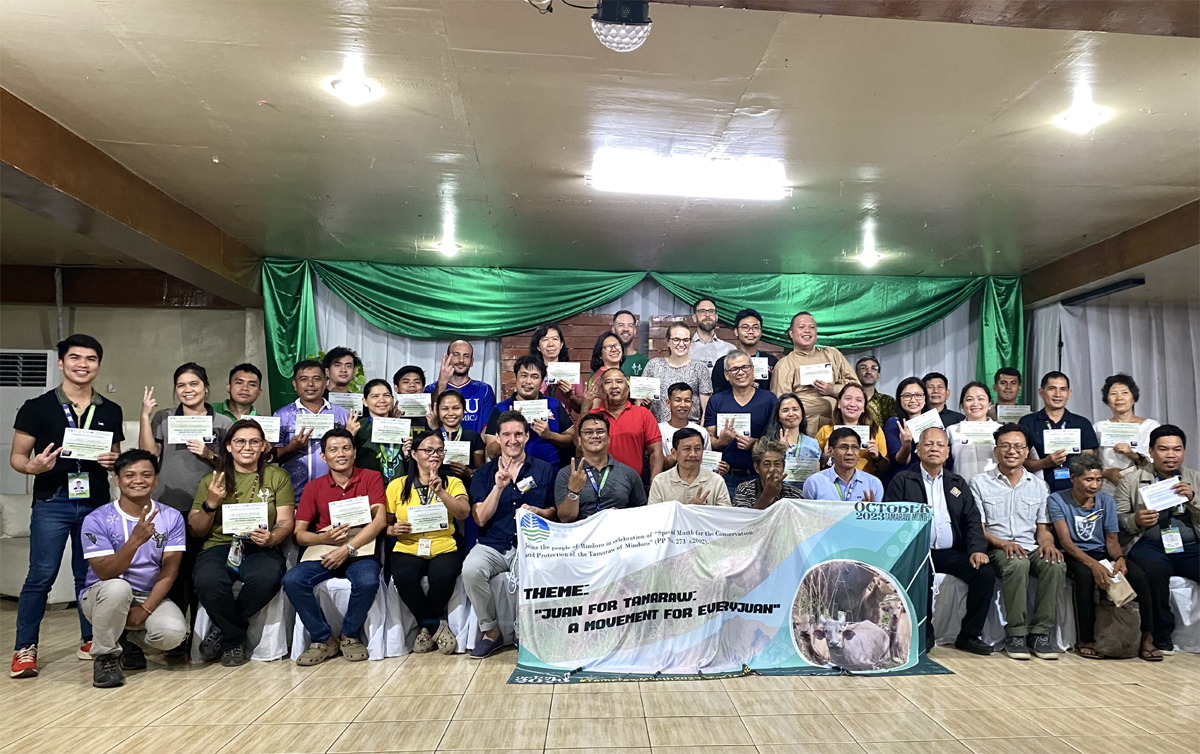
Every Tamaraw Count, representatives from other sectors and potential collaborators are being invited to participate in the activity. The purpose of this is to show transparency, dependability and integrity of the study as well as encourage participants to join in the conservation of the Tamaraw through partnership in research undertakings, among other
The latest estimated Tamaraw population in MIBNP displays an increasing trend and this gives good hope for the conservation of the Tamaraw. Similarly, the figure manifests the excellent and dedicated performance of the Tamaraw Conservation Program (TCP) field personnel - the Tamaraw Bantay Teams (TBT) who are very much committed in doing their responsibilities towards the protection and conservation of the Tamaraw. (Maria Teresita Pineda, Jr.-David)
News
REGIONAL SYMPOSIUM ON MANGROVE ECOSYTEM IN SOUTHEAST ASIA
|
The Regional Technical Director for Protected Area, Wildlife and Coastal Zone Management Service, Gwendolyn C. Bambalan, DPA, CESE, has served as the Head of Delegation of the Philippine government who attended the recent “Regional Symposium on Mangrove Ecosystem in Southeast Asia” held in Surabaya, Indonesia last February 27 to March 01, 2013.
|
|
PROJECT UPDATING: Tamaraw Conservation Project (TCP) and New Conservation Areas in the Philippines Project (NEWCAPP)
![]() |
Two of the projects currently undertaken by The Protected Areas, Wildlife and Coastal Zone Management Sector (PAWCZMS) of DENR-IVB-MIMAROPA are Tamaraw Conservation Project (TCP) and New Conservation Areas in the Philippines Project (NEWCAPP). TCP is a government initiative to save Tamaraws from extinction. On the other hand, NEWCAPP aims to expand and strengthen the terrestrial protected area (PA) system in the Philippines by developing new PA models and building capacity for effective management of the system. |
![]() ![]() |
|
More News
- BIODIVERSITY PARTNERSHIPS PROJECT MEETING WITH MT. SIBURAN’S INDIGENOUS PEOPLE
- ORIENTATION-WORKSHOP ON CAVES AND CAVE RESOURCES CONSERVATION AND MANAGEMENT WITH FIELD PRACTICUM
- DENR RIV B HOLDS PRESSCON AT CALAPAN CITY, ORIENTAL MINDORO
- DENR IV-B PROMOTES RESIDENTIAL FREE PATENT PER RA 10023
- PAWCZMS' ASSESSMENT AND PLANNING WORKSHOP
- SIGNING OF MEMORANDUM OF AGREEMENT FOR THE IMPLEMENTATION OF THE WESTERN MINDORO INTEGRATED CONSERVATION PROGRAM IN MTS. IGLIT-BACO NATURAL PARK